Retirement accounts abroad
Does your Roth IRA need a passport?
You spent twenty years filling a Roth IRA so that retirement would be tax-free. Then you moved to Spain, and Spain looked at your Roth the way a cat looks at a cucumber. Here's how six popular countries treat the three pillars of an American retirement: Social Security, the IRA or 401(k), and the Roth.
- Your US tax rules don't move with you. The country you live in decides how it taxes you, and the tax treaty with the US settles who goes first.
- US citizens keep filing a US return wherever they live. When both countries tax the same income, credits stop you from paying twice: you pay roughly the higher of the two bills.
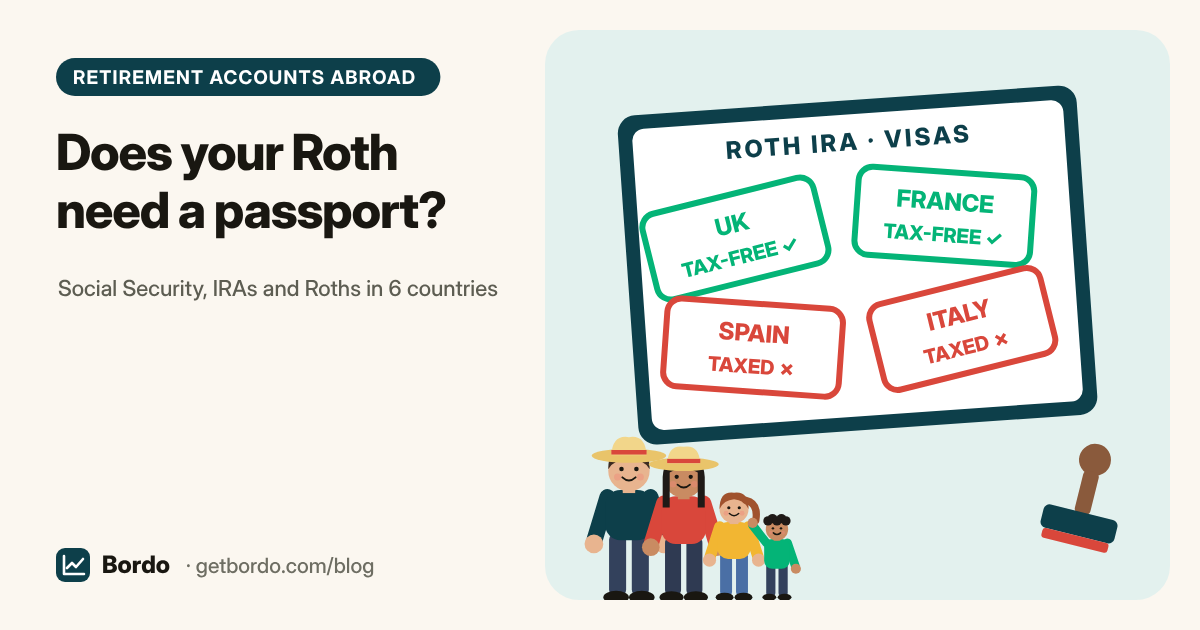
- Roth IRAs are tax-free in the UK and France, thanks to their treaties. Spain and Italy have no such thing as a Roth and can tax the growth.
- Social Security goes to different places: US-only (France), the country you live in (UK, Germany, Italy), or both with a credit (Spain, Portugal).
- The best time to plan is before you become a tax resident. After that, the country's rules apply from day one.
1. Your accounts are American. Your new country doesn't care.
A traditional IRA, a 401(k) and a Roth IRA are inventions of US tax law. Most countries have nothing like them, so they decide for themselves what your withdrawals are: a pension, investment income, or a strange American savings box. The tax treaty between the US and your new country can override that, but only where it says so explicitly. Where the treaty says nothing, local law wins.
Joke break: explaining a "backdoor Roth" to a Spanish tax adviser is a great way to make new friends, or at least to watch someone age in real time.
2. The big table
For a resident of each country receiving US money, from the treaties as they stand today (several were updated by protocols, so we used the current versions):
| Country | US Social Security | IRA and 401(k) withdrawals | Roth IRA |
|---|---|---|---|
| France | The US only, citizens included | The US only | Tax-free in both |
| UK | The UK only, citizens included | The UK (and the US for citizens, with a credit). A lump sum is taxed only in the US | Tax-free in the UK: the treaty exempts what is exempt in the US |
| Germany | Germany only, citizens included | Germany (and the US for citizens, with a credit) | The treaty says nothing: ask before you count on it |
| Spain | Both: the US first, Spain with a credit | Spain (and the US for citizens) | No Roth in Spanish law: the growth can be taxed |
| Italy | Italy (and the US for citizens, with a credit) | Italy (and the US for citizens) | No Roth in Italian law: withdrawals can be taxed |
| Portugal | Both: the US first, Portugal with a credit | Portugal (and the US for citizens) | Treated as savings: the growth can be taxed |
3. France and the UK: the Roth-friendly club
France. Since the 2004 update of the treaty, pensions and retirement accounts are taxed only by the country where the plan was set up. Your IRA, your 401(k) and your Social Security are therefore taxed only by the US, even if you're a US citizen living in Lyon. France still counts them to set the rate on your other French income, but doesn't tax them. A qualified Roth withdrawal is tax-free in the US, so it ends up tax-free everywhere. Our US to France guide has the full story, with numbers.
The UK. The UK taxes your IRA and 401(k) withdrawals as pension income, because you live there. But the treaty has a gem for Roth owners: what a US plan pays out tax-free in the US is also tax-free in the UK. And US Social Security is taxed only by the UK, even for US citizens: the IRS lets it go.
Joke break: the UK will tax your IRA, your pension and possibly your umbrella, but it respects a Roth. Very British: rules are rules.
4. Spain and Italy: "a Roth what?"
Spain has no concept of a Roth, and the US–Spain treaty doesn't mention one. Advisers agree on the risk: the growth in your Roth can be taxed as income when you take it out, with no US tax to credit against, because there wasn't any. On forums, the planning idea that comes up most is to take money out of the Roth before you become a Spanish tax resident. Ask an adviser before you do anything, because a withdrawal before 59½ has its own US penalties. IRA and 401(k) withdrawals are taxed in Spain like private pensions, and Social Security can be taxed by both countries, Spain giving a credit for the US tax.
Italy doesn't recognise the Roth either. Withdrawals can land as pension income or investment income, and Italian rates are higher than American ones. One retiree on a forum reported a first Italian tax bill of €26,000 on income that cost $1,900 in the US. Social Security paid to a resident of Italy is taxed by Italy, and the US keeps taxing its own citizens on it, with a credit.
Italy also has a famous carrot: a 7% flat tax on all foreign income for 10 years, if you receive a foreign pension, lived abroad for the last 5 years, and move to a town of fewer than 30,000 people in the south (Sicily, Sardinia, Puglia, Calabria, Campania, Basilicata, Abruzzo or Molise) or in some earthquake-hit towns of central Italy. The limit went from 20,000 to 30,000 people in April 2026, which added 74 towns. For a US citizen, remember the IRS still taxes you at US rates, and a 7% Italian tax won't fully offset that.
Joke break: a 7% tax rate, olive trees and 300 days of sun. The catch is the Italian paperwork, which is also a full-time retirement activity.
5. Portugal and Germany
Portugal closed its famous NHR regime to newcomers in 2024. Its replacement is aimed at people working in certain jobs, not at retirees, so new arrivals pay the normal rates on pensions, up to 48% at the top. The treaty lets both countries tax Social Security, with Portugal giving a credit for the US tax. IRA and 401(k) withdrawals are taxed in Portugal. Roth withdrawals are usually treated as savings: what you put in comes back untaxed, the growth can be taxed. Keep records of your contributions.
Germany taxes Social Security paid to its residents, and since 2008 the US doesn't, even for citizens: the German treaty is one of the few where the IRS steps aside. Germany taxes it like its own state pension. Your IRA and 401(k) withdrawals are taxed in Germany too. On the Roth, the treaty is silent: get a German tax adviser's opinion before you build a plan on it.
6. What to do before you move
- List your accounts and how each one is taxed in your target country. The table above is the starting point.
- Look at the timing: what you sell or withdraw before you become a resident is usually a US-only event.
- For a Roth in Spain, Italy or Portugal, ask an adviser whether to take money out before the move, and keep a record of your contributions.
- Check which country's tax rate is higher on each income, because with credits you'll pay roughly the higher one.
- Remember the visa: some countries count only certain incomes. See Can I retire there on my savings?
7. Before you go: your plan Pro
A move like this needs a plan and a checklist. Which accounts to keep, what to sell before you go, which visa fits your income, and the forms to file in both countries each year. Every household's list is different, so Bordo Pro builds yours: each step with its date, the forms for your situation and a reminder before every deadline.
Bordo works out your monthly paycheck from your savings and your taxes where you live, free. Try a country before you pack.
This guide shares the rules as we understand them in October 2026, from the treaty texts and official sources. It is not tax, legal or immigration advice: rules change, and consulates and tax offices differ, so check your own case with a licensed adviser in each country. More guides: Moving from the US to France, Moving from France to the US, Can I retire there on my savings?, Zero tax in Dubai, says the brochure.