Visas for retirees
Can I retire there on my savings? The visa reality check
You've done the hard part: years of saving, a spreadsheet that says "enough", and a shortlist of countries with better bread than yours. Now the easy part, right? Not quite. Money alone doesn't open every door, and the doors that do open each want a different number. Here's the reality check, country by country.
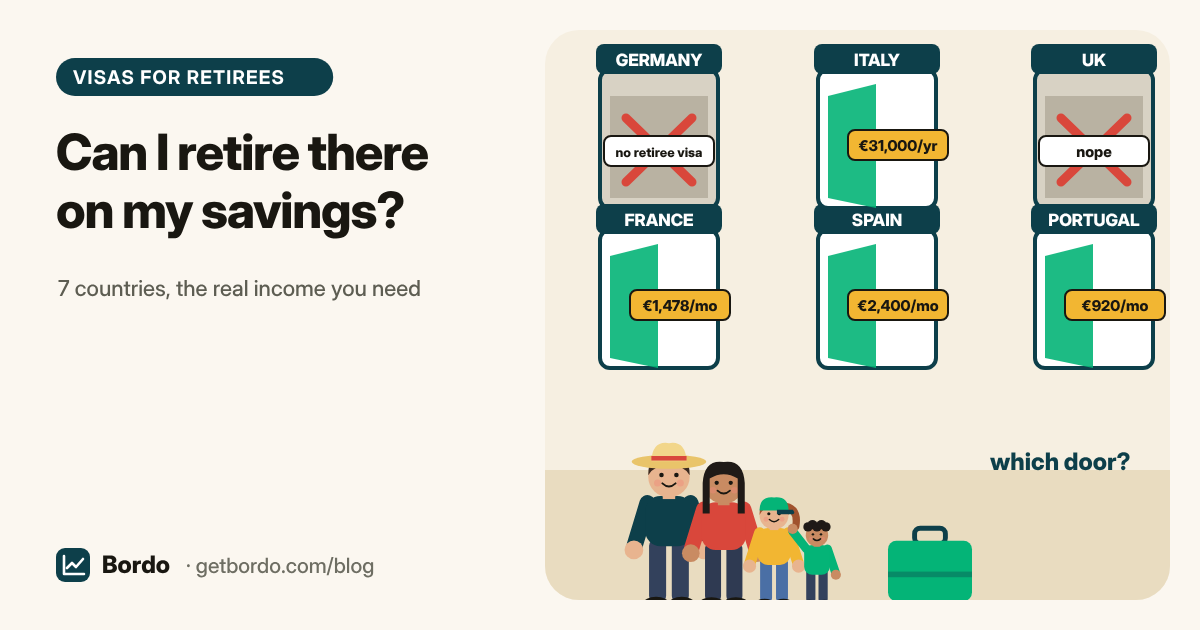
- Germany and the UK have no visa for people who simply want to retire on their savings.
- France, Spain, Portugal, Italy and Ireland do, and each asks for a minimum income: from about €920 a month in Portugal to €50,000 a year in Ireland.
- None of these visas lets you work in the country. Some don't even like remote work.
- Consulates differ on what counts as income: pensions always do, dividends and withdrawals from savings sometimes don't.
- The visa is step one. Taxes start the day you become a resident, so plan both together.
1. The doors that are closed
The UK has no retirement visa, for anyone, from anywhere. Being comfortable, insured and charming is not a route. On expat forums, this is the most repeated correction of all, and it usually comes with a suggestion: look at Ireland instead.
Germany has no retirement visa either. Retirees apply for a general residence permit, and the local foreigners' office decides case by case. Expect to show income well above the German poverty line, German health insurance and basic German. Health insurance is the real wall: once you're resident, foreign or travel insurance doesn't count, and private German plans get expensive with age. Forum members in their 70s report giving up and going home.
Joke break: Germany will happily sell you a beer, a castle tour and a train ticket. Retirement is sold separately, with a form, in German.
2. The doors that are open, and the price on the tag
| Country | The visa | Income asked, 2026 | Good to know |
|---|---|---|---|
| Portugal | D7 (passive income) | €920 a month (the minimum wage), +50% for a spouse, +30% per child | Also about a year of that income in savings. Renewals now ask for a social security number (NISS). |
| France | Long-stay visitor visa | About €1,478 a month net (the French minimum wage), per person | A floor, not a target: aim for more. You sign a promise not to work in France. |
| Spain | Non-lucrative visa | €28,800 a year (€2,400 a month), +€7,200 per family member | Private health insurance from a company operating in Spain, with no co-payments. |
| Italy | Elective residence visa | About €31,000 a year, more for a couple | Strictly no work, not even remote work for a foreign employer. Consulates may want 2–3 years of income history. |
| Ireland | Stamp 0 | €50,000 a year per person | Plus savings for big unexpected costs, and private health insurance. No public services or benefits. |
The figures change every year, usually with the minimum wage or a reference index, and each consulate can ask for more. Check with the consulate for your home address before you apply.
3. "Income" doesn't always mean your income
Here's the trap for early retirees. A pension is the income consulates love: regular, guaranteed, boring. But if you live on dividends and withdrawals from your portfolio, some consulates will frown. Italy's consulates are known to ask whether the income is "stable and recurring", and some have refused dividend income. Spain has historically preferred pensions, annuities and rent. Others look at your savings instead of the income.
So bring the paperwork that makes your portfolio look like a pension: statements showing years of regular payments, a dividend history, a letter from your bank. And apply in the right place: it's usually the consulate for the US state or country where you live, and they don't all read the rules the same way.
Joke break: to an Italian consulate, "4% safe withdrawal rate" sounds a lot like "I plan to sell things".
4. Further afield: Dubai
The United Arab Emirates has a real retirement visa, for people over 55: about AED 20,000 a month of income, or AED 1 million in savings, or a property worth AED 1 million. It lasts five years and can be renewed. The tax side has a twist for Americans, which we unpack in Zero tax in Dubai, says the brochure.
5. Your visa is not your tax plan
Getting the visa makes you a resident, and residents usually pay tax on their income from everywhere, from day one. Spain counts you after 183 days, or sooner if your spouse and children live there. Italy and Portugal tax pensions at normal rates, and some countries tax your Roth IRA. Read Does your Roth IRA need a passport? before you pick a door.
- Shortlist the countries where you qualify, with a margin above the minimum.
- Make your income easy to prove: 2–3 years of statements, and a dividend or withdrawal history.
- Price the health insurance the visa needs, at your age.
- Pick the move date with taxes in mind, not just the weather.
6. Before you go: your plan Pro
A move like this needs a plan and a checklist. Which accounts to keep, what to sell before you go, which visa fits your income, and the forms to file in both countries each year. Every household's list is different, so Bordo Pro builds yours: each step with its date, the forms for your situation and a reminder before every deadline.
Bordo works out your monthly paycheck from your savings and your taxes where you live, free. Try a country before you pack.
This guide shares the rules as we understand them in October 2026, from the treaty texts and official sources. It is not tax, legal or immigration advice: rules change, and consulates and tax offices differ, so check your own case with a licensed adviser in each country. More guides: Moving from the US to France, Moving from France to the US, Does your Roth IRA need a passport?, Zero tax in Dubai, says the brochure.