Retiring in Dubai
Zero tax in Dubai, says the brochure
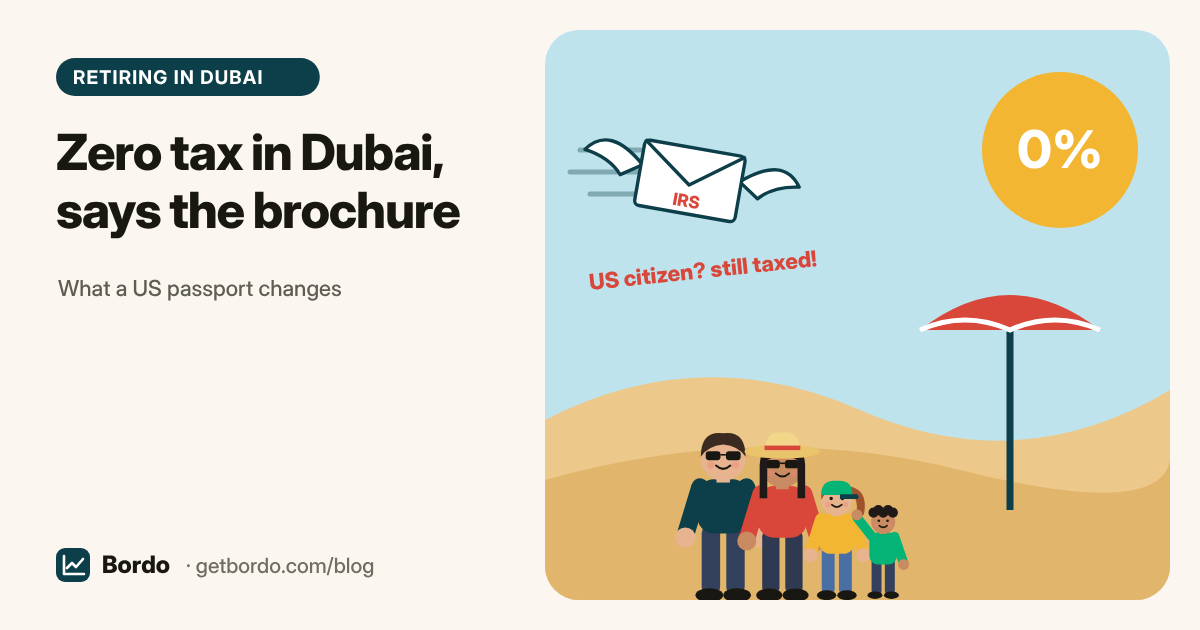
Sunshine, beaches and a 0% income tax. Dubai's brochure is very persuasive, especially if you've just read your US tax bill. But if you're American, there's a small detail in the fine print: you. Here's what really happens to your retirement money in the United Arab Emirates.
- The UAE has no personal income tax. True, and lovely.
- US citizens pay US tax wherever they live, so for them Dubai is roughly as tax-friendly as Florida or Texas: no state tax, the same federal tax.
- The US and the UAE have no income tax treaty. If you're not a US citizen, the US keeps 30% of your US dividends, not the 15% most treaty countries get.
- Non-citizens also lose 25.5% of their Social Security to US withholding.
- The UAE retirement visa is for people over 55 with about AED 20,000 a month of income, or AED 1 million in savings or property.
1. The IRS has a passport too
The US taxes its citizens on their income from everywhere, wherever they live. Moving to Dubai removes your state tax (if you leave your state properly) but not a cent of federal tax on your dividends, gains, IRA withdrawals or Social Security. The foreign earned income exclusion only covers income from working, not a retiree's investment income.
The UAE taxes none of it, so there's nothing to credit: you simply pay the US bill. In practice, a retired US citizen in Dubai pays about what they'd pay in Florida, with better sand.
Joke break: the IRS doesn't do goodbyes. It doesn't do sunbathing either, but it will happily wait for you at the pool.
Your US paperwork stays the same as anywhere abroad: Form 1040 every year, the FBAR once your foreign accounts pass $10,000, and Form 8938 above $200,000 at year end ($400,000 for a couple) while living abroad.
2. Not a US citizen? The missing treaty bites differently
If you're not a US citizen (say a European who worked in the US, or a former green-card holder), you don't file US returns on your world income anymore. But the US still taxes its own income at the source, and that's where the missing treaty hurts:
| US income | Living in a treaty country (Spain, France…) | Living in the UAE |
|---|---|---|
| Dividends from US shares and ETFs | 15% kept by the US | 30% kept by the US |
| Social Security | Depends on the treaty, often 0% in the US | 25.5% kept by the US (30% on 85% of it) |
| Interest on US bank deposits and most bonds | Usually 0% | Usually 0% |
| Gains when you sell US shares | Usually 0% in the US | Usually 0% in the US |
An example: $30,000 of US dividends a year. In a treaty country the US keeps $4,500, and your new country may tax the rest with a credit. In Dubai the US keeps $9,000, and the UAE keeps nothing. So "zero tax" really means 30%, on dividends at least.
Joke break: Dubai has seven-star hotels, but your dividends fly economy.
3. Leaving the US for good? Mind the exit
Green-card holders can leave the US tax system by formally giving up the card. Watch for the US "exit tax": it can apply if you held the card in 8 of the last 15 years and your net worth tops $2 million, or if your US tax over the last five years was above a set amount. Talk to someone before you mail the card back. US citizens can give up citizenship too, with the same exit tax test and a big decision attached; it's not a tax trick, it's a life choice.
4. The visa: Dubai's retirement route
The UAE has a retirement visa for people over 55. You need one of these:
- About AED 20,000 a month of income (around $5,400), from a pension or other retirement income
- AED 1 million in savings in the UAE (around $272,000)
- A UAE property worth at least AED 1 million
The visa lasts five years and can be renewed. Health insurance from an approved UAE insurer is required, and you can usually sponsor a spouse and children. Check the current rules with the emirate before you apply, because they change.
Elsewhere, the visa picture is very different: see Can I retire there on my savings? for Europe.
5. Who Dubai works for
- Non-Americans with little US income, or with funds outside the US: genuinely low tax.
- US citizens: about the same federal tax as a no-income-tax state, plus a very different life. Come for the life, not the tax.
- Non-citizens with big US dividend portfolios: do the math on the 30%. Holding non-US funds can change it, but foreign funds have their own rules if you ever become a US taxpayer again.
6. Before you go: your plan Pro
A move like this needs a plan and a checklist. Which accounts to keep, what to sell before you go, which visa fits your income, and the forms to file in both countries each year. Every household's list is different, so Bordo Pro builds yours: each step with its date, the forms for your situation and a reminder before every deadline.
Bordo works out your monthly paycheck from your savings and your taxes where you live, free. Try a country before you pack.
This guide shares the rules as we understand them in October 2026, from the treaty texts and official sources. It is not tax, legal or immigration advice: rules change, and consulates and tax offices differ, so check your own case with a licensed adviser in each country. More guides: Moving from the US to France, Moving from France to the US, Does your Roth IRA need a passport?, Can I retire there on my savings?.