Life after FIRE
What early retirement with kids actually looks like

When people hear I retired early, they picture a hammock. Maybe a boat. Some of them picture me bored out of my mind by the second month. The truth is less glamorous and a lot more ordinary: my weeks are full, some things I expected to be easy turned out hard, and the thing that eats the most time is a house. Here's what a normal stretch of my life looks like, with two kids, no job and no alarm clock (mostly).
The mornings: tennis one day, sport the next
The kids leave for school, and my wife and I leave for the courts. We play tennis together often, and on the other mornings we do another sport. It's the one part of the schedule we protect like a meeting with my old boss.
I didn't plan it this way. In the first weeks I let the mornings drift, and by eleven I'd done nothing and felt strangely tired. Moving first thing changed the whole day. It also turned out to be the easiest way to meet people: on a tennis court, nobody asks what you do for a living, which is convenient when the honest answer is "nothing, on purpose".
The biggest surprise wasn't the free time. It was getting my wife back. For years we passed each other between meetings, school runs and airports. Now we do a lot together: tennis in the morning, errands, projects around the house, dinners with friends, planning the next trip. Some people worry that spending all day together after retirement will be too much. For us it has been the best part.
When I was working, exercise was the first thing to go in a busy week. Now it's the first thing in every day. If I had to name one change that made early retirement work, it's this one, and it costs almost nothing.
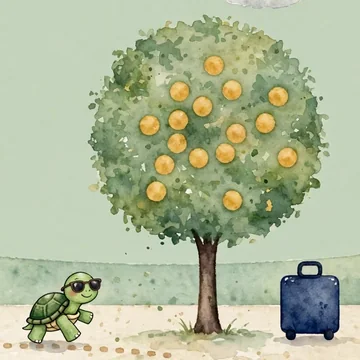
My backhand has improved more since I retired than my portfolio has. My wife's has improved even more, which she mentions after every match. Please don't tell the turtle; he's very proud of the portfolio.
Trying to get consulting work (it's harder than I thought)
I'll be honest about this one, because nobody told me. I assumed that once I stopped working full time, a bit of consulting would come easily: a few projects a year, enough to stay sharp and keep a foot in the door.
It hasn't. Finding consulting work is hard. The people who used to call me were calling the job title, not me, and once the title was gone, so were most of the calls. Companies that would happily have hired me as an employee are much more cautious about hiring someone part time, from another country, who doesn't need the money. And selling yourself is a skill of its own, one I never had to learn when a company was selling me.
When I updated my LinkedIn profile, my old job title became "Available". Recruiters seem to read that as a cry for help. Any French mother would read it as "unemployed". Both are technically right.
We don't need the income: our plan pays the bills without it. What I miss is the structure and the feeling of being useful to someone outside the family. I'm still trying. If you're planning to retire early with "a bit of consulting" as part of the plan, my advice is simple: start lining it up while you still have the job and the network, and don't count on that money in your numbers.
Learning a few things
With time back, I started learning a few things I'd always pushed to "later". Some stuck, some didn't. The lesson for me wasn't what I learned but how: at work, learning came with a deadline and a reason. Now it only happens if I make a slot for it in the week, the same way I do for tennis. Without the slot, "I'll learn it this week" quietly becomes "I'll learn it next year".
So far, the main thing I've learned is that every online tutorial lasts ten minutes, and the thing it teaches takes four hours, two trips to the shop and one call to a friend who actually knows.
Dinner with friends, often
This is the part of early retirement I like most, and it's the least glamorous to describe. We have dinner with friends often: at home, at theirs, in a small restaurant down the street. During our working years, seeing friends needed a calendar invite three weeks ahead and usually got cancelled anyway.
A few things I noticed. Long dinners on a weeknight are suddenly possible, because nobody needs to be sharp at 8am. The friendships that grow are the ones you feed regularly, not the big occasional reunions. And it's the best value for money in our whole budget: a table, some food, good people. No financial plan I've ever built had a line for it, and it's the one I'd defend first.
Our biggest early-retirement expense isn't travel. We live in France: it's cheese.
Travelling Europe, on the kids' calendar
Here's the paradox of retiring early with children: you're free all year, and the kids are not. School holidays decide when we travel, so we visit Europe during the kids' vacations, along with everyone else.
That means the busy weeks, the higher prices and the full trains. We've accepted it; seeing places together with the kids is the point. What helps is booking early, choosing places a little off the obvious route, and staying longer in one spot rather than racing between cities. The truly slow, off-season travel will come later, when the kids have grown up and left. For now, the school calendar is our travel agent.
I'm convinced the airlines receive the French school holiday calendar before the parents do. The day it's published, every ticket to anywhere sunny doubles in price, as if by magic.
The house: the job nobody warned me about
If you'd asked me before retiring what would take most of my time, I would never have said "the house". It does. Fixing the house takes a lot of time: one repair leads to another, a small project becomes a weekend, then three, and something always needs a part that arrives next week.
Part of it is that I now do things myself that I used to pay someone for, because I have the time. Part of it is that, living in it all day, you notice everything. I've learned to keep a list, pick one project at a time, and accept that a house is never finished. It's also, I'll admit, oddly satisfying: after years of work where results took months to show, fixing a door that now closes properly is a small, immediate win.
I retired from one job and accidentally took another, with a tougher boss: the house. It never says thank you, it sets deadlines with leaks, and the pay is negative.
What I'd tell someone about to retire early with kids
- Build the week before you need it. Fixed anchors (sport in the morning, dinners with friends, a learning slot) stop the days from melting into each other.
- Don't count on consulting money. If you want it, start building it before you leave, and treat it as a bonus, not as part of the plan.
- Plan travel around school holidays, and budget for peak prices. The cheap, slow travel comes later.
- Budget time for the house, not only money. It will take more of both than you think.
- Protect the friendships. They're the part of this life I'd least want to give up.
None of it looks like the hammock. All of it is better than I imagined. And on the days I wonder whether we can afford this life for another forty years, I open my own paycheck calculator, look at the plan, and go back to the house: there's a door that needs fixing.
The turtle, for the record, retired at birth. He swims in the morning, eats with friends, travels slowly and carries his house on his back, so it never needs fixing. I'm working on it.
If you've retired early with children too, I'd love to know how your weeks look. The weekly email is the best way to follow along.
This is my own experience, not advice: every family, budget and country is different. More reading: Retired before 50: so what do you do on a Tuesday? · My story.